
EOR Canada services for teams
employing in Canada’s provinces.
After you pick a candidate, we issue a contract for their province, collect the TD1 forms, add the hire to our CRA payroll account and our WSIB or CNESST cover, and set up vacation pay. You direct the work. The first payslip comes with tax, CPP and EI already deducted.
Share a role
Your hire, our Canadian payroll team, and no one else
The same fee at any salary and in any province, from a Toronto developer to a Montréal sales lead.
Ontario, British Columbia, Alberta and Quebec rules sit behind each contract.
Paid by employer and employee alike up to CAD 74,600 (CRA), capped pay by pay.
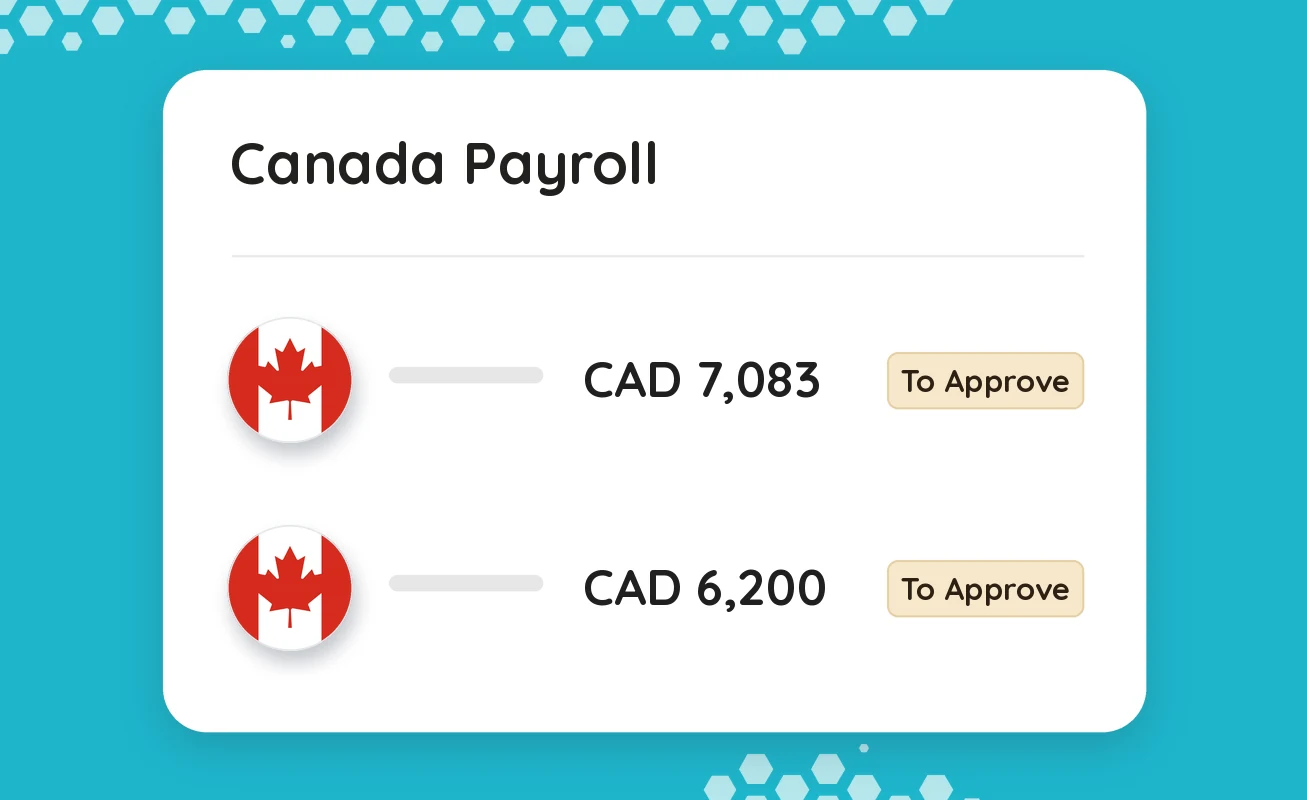
Salary, CPP, EI, provincial levies and the fee on one bill.
Who answers ESA questions when your managers sit outside Canada?
Ontario’s Employment Standards Act and Quebec’s Act respecting labour standards rarely match the rules your managers know. We close that gap for every hire.
- Probation wording and the 3-month rule
- Vacation, vacation pay and the 9 Ontario ESA public holidays tracked
- Sick days: 3 unpaid in Ontario, 5 paid plus 3 unpaid in BC
- Changes to pay, hours or duties agreed in writing first
- Restructuring and Ontario mass-termination notice
- Exits, final pay and the Record of Employment
Termination is where employers from outside Canada are most often caught out. Ontario’s ESA minimum is 1 week’s notice for under a year of service, rising to 8 weeks at 8 years, yet courts can award common-law “reasonable notice” far above that unless the contract has a termination clause that meets the ESA. We review that clause before any offer is signed.
What changes a Canadian payslip during 2026?
Net pay in Canada moves during the year even when salary stays flat. CPP stops once earnings pass CAD 74,600, then CPP2 at 4% runs to CAD 85,000; EI stops at CAD 68,900 of insurable earnings. Tax is withheld under the CRA T4127 formulas for the province of employment, so a remote hire’s province matters. We run each cycle and remit to the CRA, and to Revenu Québec for Quebec staff.
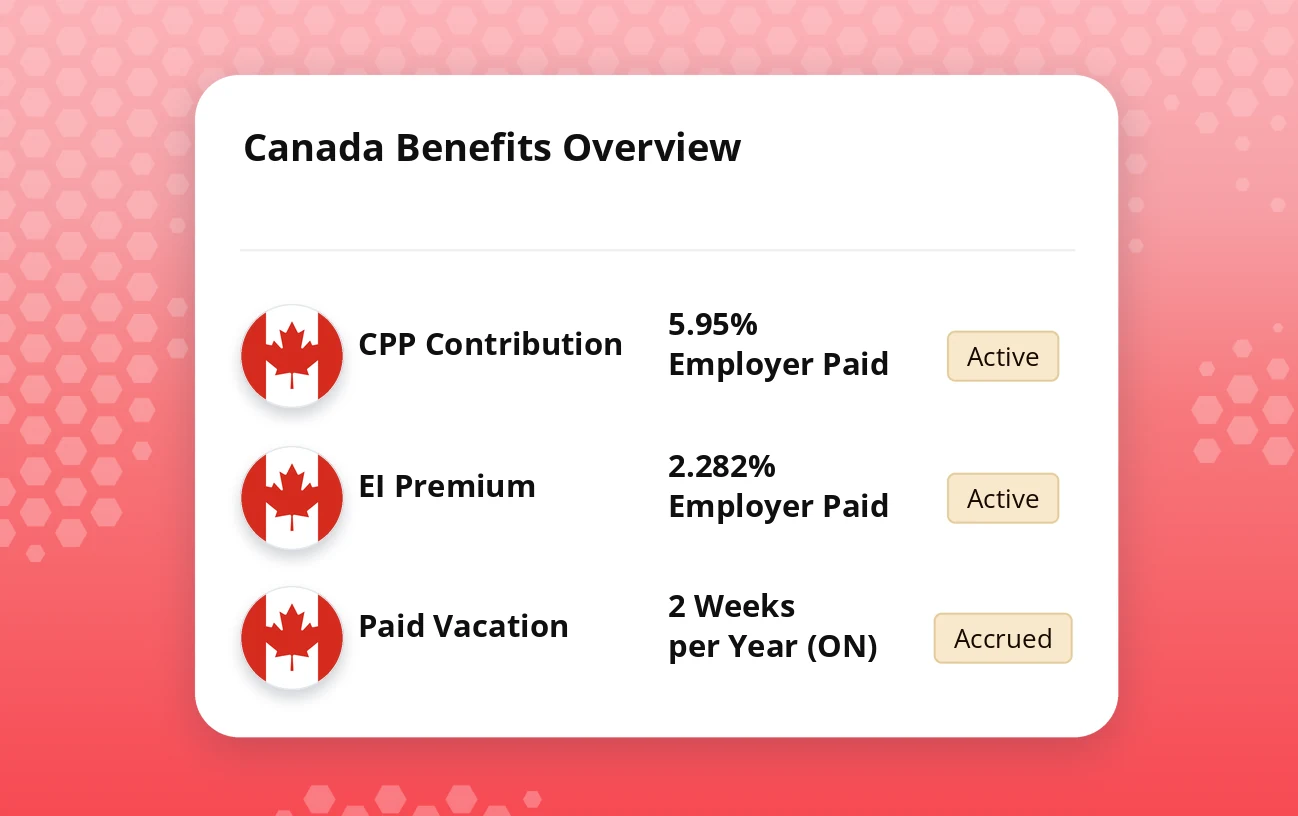
- Pension: 5.95% CPP to the CAD 74,600 ceiling, 4% CPP2 above it (CRA, 2026)
- EI at 1.63% employee and 2.282% employer, to CAD 68,900 insurable (ESDC)
- Ontario EHT and WSIB premiums on the employer side
- Quebec: QPP at 6.30%, QPIP and the Health Services Fund
- Year-end T4 filing and ROE Web records after any exit
Which extras do Canadian candidates look for?
Canadian candidates tend to compare offers on what sits above the statutory floor: extended health and dental cover, a group retirement plan, more paid time off than the 2-week ESA minimum and a top-up during parental leave. Each extra carries its own tax and payroll treatment, and Quebec can differ from the other provinces. We set that treatment up before the first pay run, so the T4 and the payslip show each benefit correctly.
- Extended health and dental plans
- Group RRSP or pension matching
- Vacation above the 2-week ESA minimum
- Top-ups to EI or QPIP parental benefits
- Life and disability insurance
Four roles in one Canadian employment
The employment contract is signed by EOR Canada as employer of record, which holds the CRA payroll account and provincial registrations, and is named on the T4 and ROE.
You set goals, hours and priorities and review the work, as you would with staff at home.
We withhold tax, CPP or QPP and EI each pay, remit by the CRA due date and keep the records.
Ontario bans non-compete clauses for non-executive staff in contracts made since 25 October 2021, though non-solicitation and confidentiality clauses remain allowed. Quebec requires working documents for staff in French under the Charter of the French Language. We raise both before the offer goes out.
How do listed EOR fees compare?
Some rivals advertise a cheaper entry price, and several of them appear in this table. The from USD 560 monthly fee buys Canadian employment with us as employer of record, payroll in every province, CRA and Revenu Québec filings, and HR answers on the ESA and Quebec rules.
| EOR CanadaCanada only | Deel | Multiplier | Remote | Pebl | RemoFirst | Oyster HR | |
|---|---|---|---|---|---|---|---|
| Monthly fee | from USD 560 | USD 599 | USD 459–559 | USD 699 | $399 | From USD 199 | USD 699 |
| EOR fee shown on pricing page | ✔ | ✔ | ✔ | ✔ | ✔ | ✔ | ✔ |
| Flat fee, not a ‘from’ price | ✔ | ✔ | ✔ | ✔ | – | ✖ | ✔ |
| Fee charged monthly per employee | ✔ | ✔ | ✔ | ✔ | ✔ | ✔ | ✔ |
| Separate fee for Canada named on the pricing page | ✔ | ✖ | ✖ | ✖ | ✖ | ✖ | ✖ |
| Fee also shown in Canadian dollars (CAD) | ✔ | – | – | ✔ | – | – | – |
| Covers Canada only, no other countries | ✔ | ✖ | ✖ | ✖ | ✖ | ✖ | – |
| Worked Canadian cost example published | ✔ | – | – | – | – | – | – |
| Currency of fee stated | ✔ | ✔ | ✔ | ✔ | – | ✔ | ✔ |
| Headline fee set in US dollars | ✔ | ✔ | ✔ | ✔ | – | ✔ | ✔ |
Fees as each provider lists them on its own pricing page, checked 25 September 2026, per employee per month. A dash (–) means that point is not stated on the provider’s pricing page. Multiplier lists USD 459 to 519 billed annually or USD 499 to 559 monthly, plus mandated add-ons and implementation fees where they apply. RemoFirst shows a starting price only; Pebl (ex Velocity Global) names no currency. Our fee converts to CAD 790.56 on ECB rates for 24 September 2026.
Send the province and salary; we send the cost
Tell us the role, the province the person will work in and the proposed salary. We reply with the 2026 employer cost, the fee and the contract points to settle.